
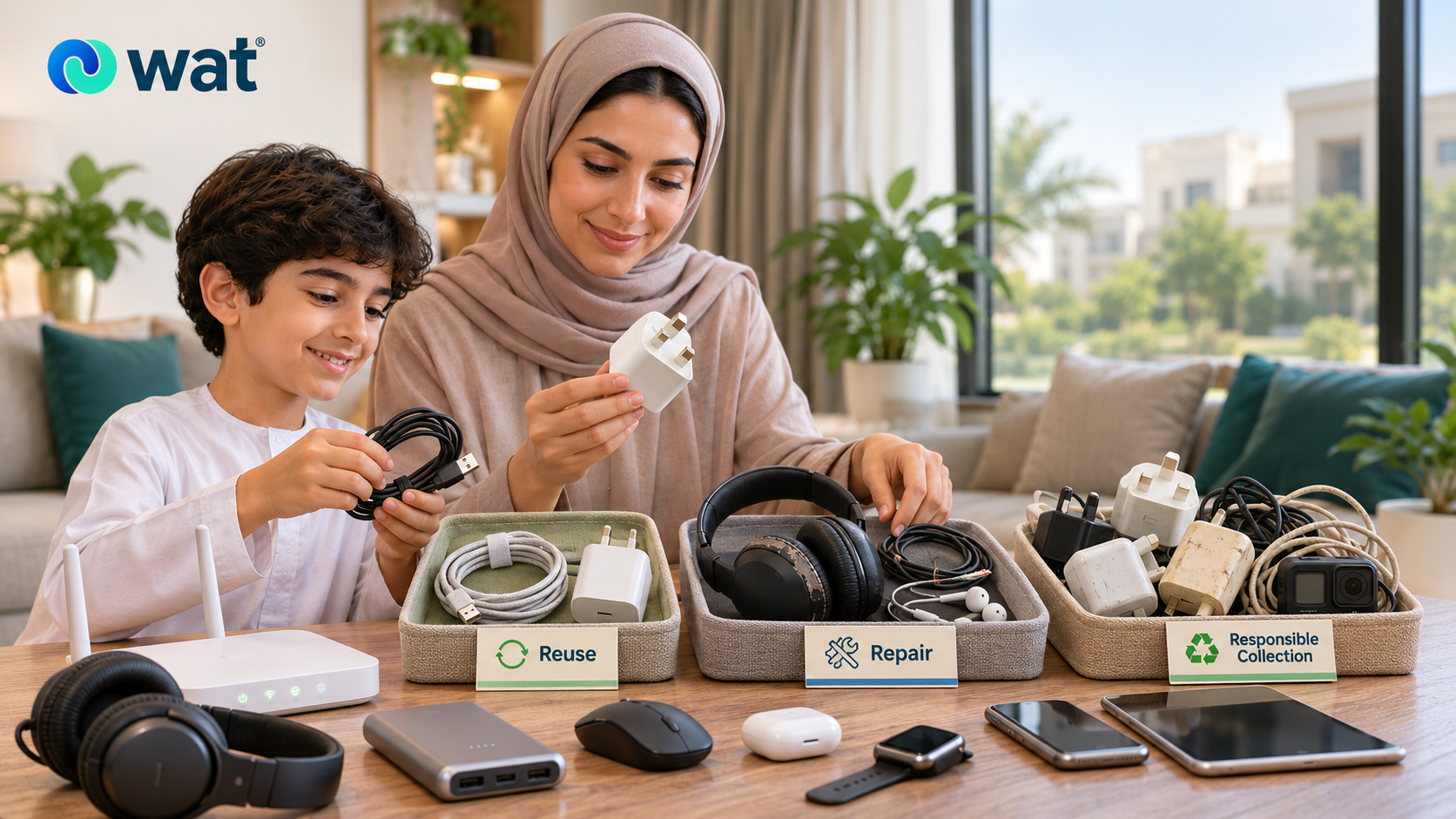
Old chargers and cables rarely feel urgent.
They are small, easy to store, and easy to forget. One extra phone charger goes into a drawer. A few old cables stay in a box. A pair of broken headphones sits on a shelf. A power bank, router, camera, tablet, or small gadget is kept because someone may need it later.
Over time, these items quietly build up inside homes.
The problem is that chargers, cables, and gadgets are still electronics. Some may contain metals, plastics, batteries, circuit boards, or data-bearing parts. Some may still work. Some may be repairable. Some may need secure handling. Some may be ready for responsible recycling.
That is why they should not be treated like ordinary household waste.
For households in the UAE, the better approach is simple: separate old electronics early, decide whether they can be reused or repaired, and move items that are no longer needed into a responsible e-waste route.
Why chargers, cables, and gadgets are easy to overlook
Large electronics usually get more attention.
People notice an old television, printer, laptop, or desktop computer because it takes up space. Smaller electronics are different. They disappear into drawers, bags, cabinets, storage boxes, and kitchen shelves.
That is why household e-waste often starts with items that look too small to matter:
- phone chargers
- laptop chargers
- USB cables
- power adapters
- extension cords and small wires
- headphones and earphones
- computer mice and keyboards
- small speakers
- power banks
- old routers
- cameras and accessories
- wearables and small smart devices
- gaming accessories
- small gadgets that still work but are no longer used
These items may not feel like “proper” e-waste, but many of them still belong in a responsible electronics collection route rather than regular trash.
What counts as household e-waste?
A useful way to think about household e-waste is this:
If the item has a plug, a battery, a cable, a circuit board, a charging port, or electronic components, it should not go into regular household waste.
This can include small accessories such as chargers and cables, but it can also include larger or data-bearing devices such as phones, tablets, laptops, cameras, routers, and hard drives.
This distinction matters because different electronics need different handling. A cable is not the same as a phone. A charger is not the same as a tablet. A power bank with a swollen battery is not the same as a working keyboard.
The goal is not to treat every item the same way. The goal is to keep electronics out of regular trash and move them into the right next step.
Small electronics are a bigger issue than they seem
WEEE Forum and UNITAR have highlighted the problem of “invisible” e-waste: small electronic items that people often do not recognize as e-waste. Their analysis found that around 9 billion kg of this type of e-waste is generated globally each year. It also found that 950 million kg of cables containing recyclable copper were discarded in one year.
This is a useful reminder for households in the UAE too. Old cables, chargers, gadgets, toys, small appliances, power banks, and accessories may look minor on their own, but together they can become a meaningful part of the e-waste problem.
The right response is not panic. It is better sorting, better storage, and a responsible collection route when the item is no longer needed.
Working gadgets should not be wasted
Responsible e-waste handling is not only for broken items.
Many household electronics are still working when people stop using them. A charger may still work after a phone upgrade. A router may be replaced by a newer model. A pair of headphones may be unused because someone bought another pair. A tablet may still turn on, but no one in the home uses it anymore.
These items should not automatically be thrown away.
A working gadget may be suitable for reuse, repair, repurposing, or responsible collection. Even if the item eventually goes into recycling, it should first be separated from regular waste so it can be reviewed properly.
When repair or reuse may be the better option
Before sending an item into a collection route, ask whether it can still be used safely.
Repair or reuse may make sense when:
- the charger, cable, or gadget still works safely
- the device has a minor repair issue
- the battery is normal and not swollen or damaged
- someone else can realistically use the item
- the repair cost is reasonable
- the item is not outdated for its intended use
- personal data can be reviewed or removed where needed
For example, a working charger may still be useful. A pair of headphones may only need a simple repair. A small gadget may be suitable for reuse if it is safe and functional.
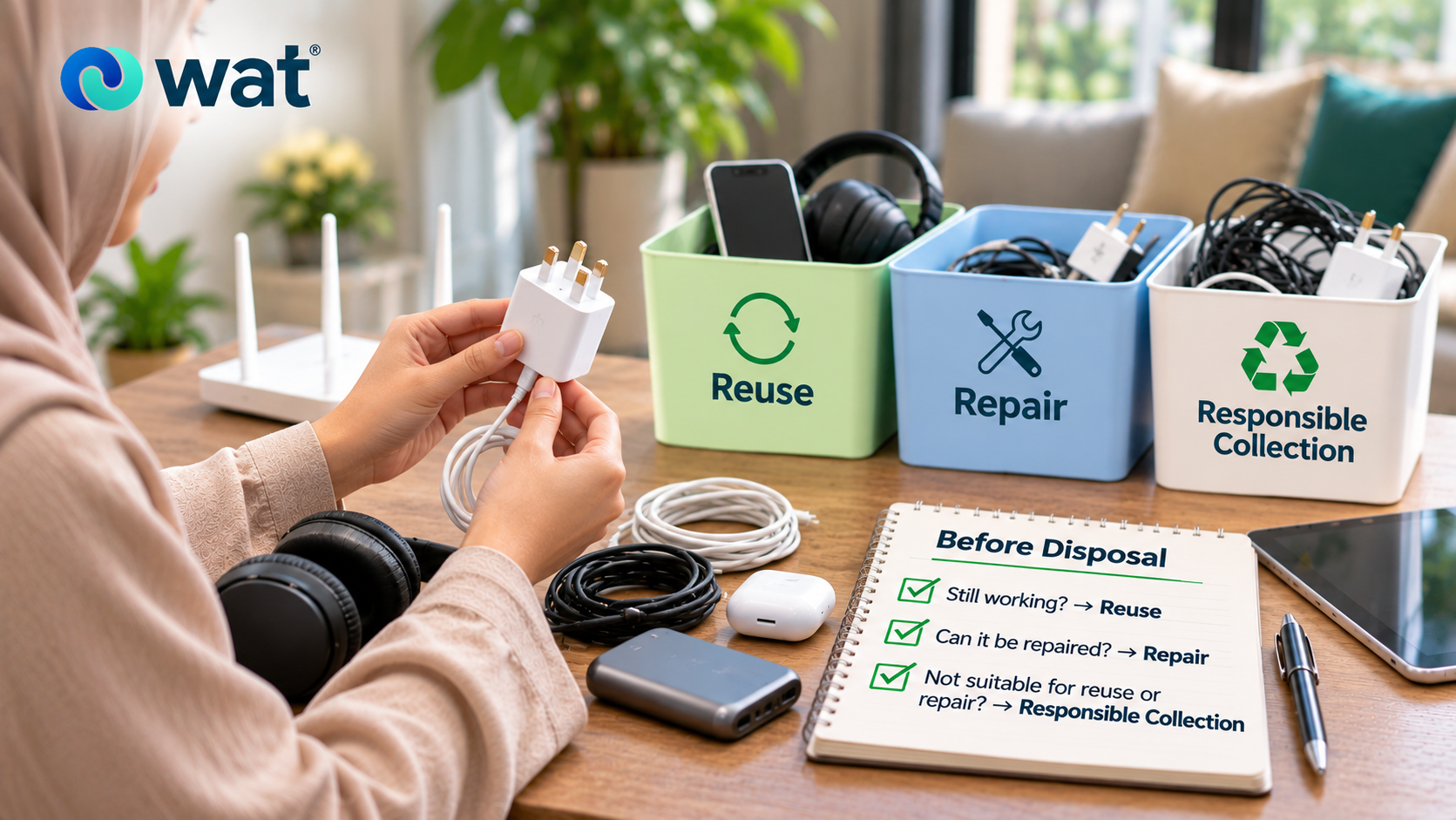
People who want to explore repair options can start with WAT’s repairers page before deciding whether an item should be repaired, reused, or moved into a collection route.
When responsible removal makes more sense
Removal may be the better option when the item is no longer needed, no longer safe, no longer useful, or has been stored for too long without a real plan.
This can apply to:
- old chargers that no longer match current devices
- phones, tablets, and laptops that are no longer used
- cables with exposed wiring or damaged ends
- power banks with swelling, heat, or leakage signs
- broken headphones or speakers
- duplicate accessories kept for years
- old routers, cameras, and smart devices
- gadgets that still work but no longer have a purpose in the home
Removal does not mean the item has no value. It means the item should no longer stay unmanaged at home or disappear into regular waste.
Data-bearing gadgets need extra care
Not every household gadget is only an accessory.
Some electronics can store personal information or provide access to accounts and networks. This may include phones, tablets, laptops, cameras, memory cards, USB drives, hard drives, smart devices, routers, and certain wearables.
Before handing over any data-bearing device, people should think about whether it may contain:
- photos and videos
- saved passwords
- banking or payment apps
- emails and messages
- work or school files
- home Wi-Fi details
- cloud account access
- contacts and personal documents
This does not mean every cable or charger creates a data concern. But it does mean phones, tablets, laptops, USBs, hard drives, routers, and connected gadgets should not be treated casually.
If secure data handling is needed, the device should move into a responsible process before final recycling or handover.
How WAT can support a responsible household route
For example, a responsible e-waste company like WAT can help people in the UAE move old chargers, cables, gadgets, phones, tablets, laptops, and accessories into a more controlled collection and handling process.
WAT’s e-waste bins and collection routes are not only for small cables or accessories. Where relevant, they can also support electronics such as phones, tablets, and laptops, with extra care for data-bearing items that may require data removal, hard disk shredding, asset destruction, or another secure handling route.
The important point is that electronics should leave the home through a responsible route, not through regular trash or forgotten storage.
Need a clearer way to clear old electronics at home?
If your home has old chargers, cables, phones, tablets, laptops, power banks, headphones, routers, or small gadgets sitting unused, WAT can help move them into a more responsible collection route.
Request an e-waste collection or contact WAT to discuss how to handle household electronics more responsibly, including items that may still work, need repair, contain data, or require recycling.
How to sort household electronics before collection
A simple sort makes disposal easier and safer.
Start by grouping items into practical categories:
- working and still needed
- working but no longer needed
- repairable
- chargers and cables
- small gadgets and accessories
- data-bearing devices
- battery-containing items
- damaged or unsafe electronics
- ready for responsible collection
This helps avoid mixing everything into one drawer or bag. It also makes it easier to decide which items can be reused, which may need repair, which need secure handling, and which are ready for responsible recycling.
Be careful with batteries and damaged items
Power banks, phones, tablets, laptops, wireless headphones, smart watches, cameras, and many small gadgets may contain batteries.
If an item has a swollen battery, unusual heat, leakage, burning smell, cracked casing, or visible damage, do not store it casually in a drawer or mix it with regular household waste.
Keep damaged or battery-concern items separate, away from heat and moisture, and move them into a responsible handling route as soon as practical.
This is one reason e-waste bins and collection points should be used carefully. Electronics with battery concerns may need additional guidance rather than being mixed casually with ordinary items.
Why regular trash is not the right place
Regular household trash is not designed for electronics.
When chargers, cables, gadgets, phones, tablets, power banks, or small electronics are mixed with ordinary waste, they can lose any chance of being reused, repaired, securely handled, or recycled properly.
For a broader explanation of why electronics need a separate route, see WAT’s related blog, The Importance of the E-Waste Recycling in Dubai.
Do not wait for a perfect cleanup day
Many homes delay e-waste decisions because people wait for a full cleanup day.
That delay is how drawers become permanent storage. A better approach is to create a small routine:
- keep a small separate box or area for old electronics
- review chargers and cables every few months
- remove items that no longer match any current device
- separate anything with a battery concern
- review data-bearing devices before handover
- move unused electronics into a responsible route instead of keeping them indefinitely
A simple routine is easier to maintain than a once-a-year cleanup that becomes overwhelming.
What people should avoid
When clearing old chargers, cables, and gadgets at home, avoid:
- throwing electronics into regular household trash
- mixing chargers and cables with food waste or wet waste
- keeping damaged batteries in drawers
- assuming working gadgets have no responsible route
- handing over phones, tablets, or storage devices without checking data
- cutting or breaking cables unnecessarily
- storing old electronics indefinitely “just in case”
- treating power banks and battery-containing devices like ordinary accessories
The aim is not to make disposal complicated. The aim is to make the next step clearer.
A practical household rule
A simple rule can help:
If it has a plug, battery, cable, circuit board, charging port, or stored data, keep it separate from regular trash.
Then decide whether the item should be reused, repaired, securely handled, or sent into a responsible e-waste collection route.
For a wider look at why keeping products and materials in use matters, see WAT’s related blog, Circular Economy in the UAE.
FAQs
Can old chargers and cables be handled as e-waste?
Yes. Old chargers, cables, adapters, and similar accessories can be handled as household e-waste and should be kept separate from regular trash.
Can working gadgets be submitted for responsible e-waste handling?
Yes. An item does not need to be broken before it enters a responsible route. Working, unused, duplicate, upgraded, or unwanted gadgets may be suitable for reuse, repair, secure handling, or recycling.
Should phones, tablets, and laptops go with chargers and cables?
They can be part of an e-waste collection route, but they may need extra care because they can contain personal data and batteries. People should review data-bearing devices before handover.
What should I do with a swollen power bank or damaged battery device?
Keep it separate, avoid heat or moisture, do not place it in regular trash, and move it into a responsible handling route as soon as practical.
What is the easiest way for households to start?
Start by separating old electronics from regular trash, sorting working items from damaged items, checking data-bearing devices, and arranging a responsible collection route for items that are no longer needed.
If your home has old chargers, cables, power banks, phones, tablets, laptops, headphones, routers, or small gadgets sitting unused, they do not need to stay in drawers or end up in regular waste.
WAT can help people in the UAE move household electronics into a more responsible route, whether the item may be suitable for reuse, repair, secure data handling, or recycling.
Request an e-waste collection or contact WAT to discuss how to dispose of old chargers, cables, gadgets, and other household electronics more responsibly.